Partnering with Amtrak, the state will spend $10.6 million over the next three years to subsidize a new rail service that begins in Lynchburg and terminates at Washington’s Union Station.
By Rachana Dixit Published: October 1, 2009 The Charlottesville Daily Progress
A new, daily Amtrak train that will stop in Charlottesville before going to Washington and the Northeast received much fanfare on Wednesday as it rolled into the city’s West Main Street station.
“We’re really pushing rail and public transportation because it’s the wave of the future,” Gov. Timothy M. Kaine said during the train’s whistle-stop tour. read more
Issue #21.40 :: 10/06/2009 - 10/12/2009
New D.C. passenger train makes first local stop
State allocated $17 million for three-year commitment
BY CHIARA CANZI C-ville Weekly
“Isn’t this the darndest thing? I broke my foot for this occasion,” Meredith Richards told a large crowd at the Amtrak station off Main Street last Wednesday, gesturing to a cast. A broken foot, however, is not keeping her from enjoying one of the greatest moments in her life.
“I couldn’t be more thrilled,” she tells C-VILLE. “I don’t think I’ve been this excited since my son was born almost 40 years ago.”
Richards, founder of Cville Rail and longtime passenger rail activist, along with Amtrak and Norfolk Southern officials, Gov. Tim Kaine, Delegate David Toscano, Rob Bell, members of the Charlottesville City Council and Albemarle County Board of Supervisors welcomed the newly expanded, daily Amtrak passenger train that will pass through Charlottesville and head to Washington D.C., New York and Boston. read more
Meredith Richards, who was singled out by state officials for her dedication to bringing a passenger service through Charlottesville, greets the first train coming from Culpeper. “I couldn’t be more thrilled,” she tells C-VILLE. “I don’t think I’ve been this excited since my son was born almost 40 years ago.”
It’s not a commuter train, but ...
By Allison Brophy Champion abrophy@starexponent.com
(540) 825-0771 ext. 101 Published: August 28, 2009
The Culpeper Star-Exponent
The Piedmont Rail Coalition is on board with the new Amtrak Northeast Regional line launching Oct. 1 from Lynchburg with very affordable fares.
The group supports it in spite of a final train schedule released this week by Amtrak that does not cater to commuters. It’s not that kind of train.
The rail coalition, made up of officials from Lynchburg, Charlottesville and Culpeper, met Thursday in Charlottesville to discuss details of the Northeast Regional Amtrak and strategies for fully optimizing its use.
“Obviously we want our message to be positive and expressing gratitude for the new service,” said Culpeper Town Councilman Chris Snider, a member of the rail coalition in attendance at Thursday’s meeting. “Any new service is a bonus for us, particularly from the tourism angle.” read more
New passenger train schedule may be obstacle for business trips from Charlottesville
By Daniel Nairn Charlottesville Tomorrow Friday, April 24, 2009
After years of advocacy for better passenger rail access along the US 29 corridor, in February of 2009 the Piedmont Rail Coalition (PRC) saw their goal come to fruition when the Commonwealth Transportation Board agreed to support a new daily route between Washington D.C. and Lynchburg. This is the first time the Commonwealth has ever agreed to fund intercity passenger rail, and it opens up the possibility of more transportation options for thousands of Virginians along the corridor. However, in recent weeks an unanticipated scheduling change has threatened to jeopardize the entire project, at least in the eyes of PRC Chair Meredith Richards.
Richards, who founded both the advocacy group CvilleRail and the Piedmont Rail Coalition, had been under the impression that the planned rail service would depart from Lynchburg at 5:05 AM, arrive in Charlottesville by 6:17 AM, and reach Union Station at 8:40 AM. In fact, these times appear in a January 2008 AMTRAK document, which also states “the combination of the morning and evening trains would establish a good service pattern for business travel to and from Washington, D.C. – a first for this region.” The merit of this schedule is that it would get passengers into the nation’s capital in time for a 9 o’clock meeting, justifying rail travel for many commuters and day-trippers alike.
The proposed schedule recently released by the Virginia Department of Rail and Public Transportation (DRPT) shows the morning route to be leaving about two and a half hours later than earlier indications. The train is scheduled to leave Lynchburg at 7:45 AM, come through Charlottesville around 8:45 AM, and arrive in Union Station by 11:30 AM, giving only about a five hour window of time before the returning south-bound train leaves the station. Based on her experience, Richards said, “This schedule will bypass the lion’s share of the market that is not now riding the trains.”
But what concerns Richards most is that this new regional rail service has only been granted funds by the state for a three-year period. The future of rail along the corridor is contingent upon an acceptable performance for this demonstration project. Virginia DRPT estimates that both the service to Lynchburg and a separate new service to Richmond could together remove 1.4 million cars from highways each year, saving around 8.3 million gallons of fuel. Yet these estimations are based on peak-hour transportation projections. What happens if the service does not perform as well as expected because of scheduling that is less than ideal?
Railroad scheduling is an incredibly complex ordeal. Over the last century, the total railroad track mileage in the United States has dropped from a peak of 260,000 miles in the 1930s to under 100,000 miles today. Rail as a form of passenger transportation lasted through decades of stagnation and neglect, yet the industry of freight rail has actually undergone a resurgence in the last several years. The trouble is that the increased volumes of freight travel have not yet led to an equivalent increase in track capacity, leaving the less profitable passenger service fewer slots available for usage.
On April 1, 2009, Governor Tim Kaine joined Wick Moorman, CEO of Norfolk Southern Railway, at Lynchburg’s Kemper Street Train Station for a ceremonial signing of an agreement to begin improvements for the new passenger rail line between Lynchburg and Washington D.C. The Virginia DRPT has agreed to $43 million worth of infrastructure improvements, such as side-tracks for parking the train and parallel tracks along congested corridors, and these agreements need to be established not only with Norfolk Southern, but with three other parties that either own track or operate their own rail service: AMTRAK, CSX, and the Virginia Railway Express (VRE).
Although the Virginia DRPT makes the final scheduling decisions, each of the five parties have to sign off on the schedule. The two most significant scheduling hurdles are created by a short segment of CSX track along the route that receives heavy freight traffic and potential conflicts with an existing VRE service between Manassas and Washington D.C. Furthermore, the new rail service through Virginia is technically the extension of an existing line that runs between New York and Washington D.C., and the timing of this line needs to be taken into account as well.
However technical the issue of scheduling is, according to Richards it still remains the case that no representative from the public was at the table to express the needs of travelers and commuters when the scheduling decisions were made. All of the negotiations and contracts were held behind closed doors. The Piedmont Rail Coalition is embarking on a campaign to encourage the DRPT to engage in a public participation process. If this is unsuccessful, the coalition intends to move forward with a participation process themselves in hopes that the DRPT will join them in their efforts.
The Virginia DRPT considers the schedule they have posted to be tentative. Although all of the agreements between the five parties have already been secured, the contracts list the scheduling as an “exhibit,” which leaves AMTRAK with a certain degree of flexibility.
According to Richards, “This is the first new passenger service for the US29 corridor in 53 years. It is a great gift to our region, for which we are extremely grateful. But we have one chance to get it right. And if we don't get it right, it's ‘stuck on the highway’ for thousands of our residents who would rather be taking the train.” She hopes that a full-fledged public participation process will ensure that the final schedule will sufficiently meet the needs of riders.
The planned start date for the new Washington D.C. to Lynchburg service of October 1, 2009 serves as a functional deadline for the scheduling decision, since nobody has an interest in seeing the new service delayed at all. However the scheduling decision is resolved, Charlottesville residents will see their options for rail travel more than double when the new service starts.
Additional Passenger Rail Service Approved
PIEDMONT RAIL COALITION CONGRATULATES STATE OF VIRGINIA ON CONTRACT APPROVALS FOR ADDITIONAL PASSENGER RAIL SERVICE
The Piedmont Rail Coalition extended its thanks to the Commonwealth Transportation Board (CTB) and the Virginia Department of Rail and Transportation (VDRPT) on today’s approval of the agreements needed to bring additional passenger rail service to the Rt. 29 corridor.
“Today’s action in Richmond will bring additional train service to passengers in the Piedmont corridor in only seven months,” said Meredith Richards, Chairman of the Piedmont Rail Coalition. “This is an important day for public transportation in Virginia, and we commend Secretary Homer and the VDRPT staff on their hard work to make this much needed service possible, and we commend the CTB for expediting approval of agreements with CSX, AMTRAK and Virginia Railway Express (VRE).”
“On October 1, 2009, the citizens of Charlottesville, Culpeper, Lynchburg and the US 29 corridor will see a significant improvement in their transportation alternatives as more and better passenger rail service comes to our region, including a direct connection to New York and Boston, as well as Washington, DC and northern Virginia,” Richards said. “Potential riders who have been continually disappointed by sold-out trains will finally be able get a seat and business travelers will be able to leave their car at home when they go to meetings in Washington. The long drive up Rt. 29 can come to an end.”
“The State’s rail plan recognized that the Piedmont Corridor was underserved by passenger rail and that there significant unmet public transportation needs,” Richards noted. “The VDRPT staff developed the partnerships with Amtrak, Norfolk Southern, CSX and VRE that were needed to bring more rail service to our region. We thank them for recognizing our needs and finding a way to make more passenger rail service a reality. ”
“There is much work to be done to start the new service, but I’m confident that I’ll be able to be riding the train on October first!”
Twenty-one jurisdictions in the Piedmont Rail Coalition passed unanimous resolutions supporting the expansion of passenger rail service in the Rt. 29 corridor, and called on the state to partner with Amtrak to initiate the new service.
Richards added that, “In these times of unstable gas prices, environmental climate change, and increasing congestion on crowded roads, the need for more frequent and reliable passenger rail service is growing more urgent every day.”
Local rail supporters are thrilled that despite the economic odds, a state-proposed $17 million three-year pilot program includes long-awaited U.S. 29 passenger rail improvements.
“Virginia has never supported passenger rail operations,” said Meredith Richards, chairwoman of the local Piedmont Rail Coalition and a former city councilor. “It’s going to be a whole new paradigm.”
But for many across the state, it could potentially represent something greater: the funds, coupled with the shift in national politics and renewed interest in infrastructure spending, they say, could bode quote well for the future of train travel.
“It’s a big step,” Charlottesville Mayor Dave Norris said.
The state demonstration program — whose subsidies in part would help finance a daily Amtrak route from Lynchburg to Washington, with stops in Charlotte-sville, Culpeper, Manassas and Alexandria — surprised most in the area. The line would cost the state $1.9 million annually to operate.
Because of the expected lack of funds, Norris said that while expanding rail and other forms of transportation exclusive of car travel are important, they were not listed as one of the City Council’s top priorities.
“We were told all along that the state has this massive budget shortfall and this may not be the year that it happens,” Norris said.
Richards said she was also skeptical, despite her and the coalition’s efforts, that a funding source would soon be identified.
“We thought it was going to be a very tough time getting this funding this year,” she said. The Commonwealth Transportation Board will vote on the funding proposal at its January meeting.
While that approval is still pending, Richards said the shift to invest in rail is already beginning, and not just statewide. Before the Nov. 4 election, Richards said, Congress passed a sizeable Amtrak funding authorization bill, large parts of which will be appropriated as state grants to expand regional rail.
“It is a massive new investment, foretold in this bill by Congress, in expanding Amtrak service,” Richards said. “I think by the time this new service starts we’re going to see at the national level a strong new emphasis on passenger rail.”
U.S. Rep.-elect Tom Perriello, who has taken Amtrak trains out of Charlottesville, said the city could use more trains running through it, and he thinks the U.S. government will be friendly to expanding rail infrastructure in the coming years.
According to a 2007 Virginia Amtrak ridership report, last year there were 48,190 boardings — riders getting on and off a train — from Charlottesville’s West Main Street station. With no service improvements, the annual Amtrak ridership between the Washington area and Lynchburg is estimated to be between 71,800 and 90,900 by 2030, according to the Virginia Statewide Rail Plan. If two daily roundtrip trains were added, annual ridership would increase to between 152,800 and 193,300 by 2030, the report stated.
“I would be very excited about having more opportunities to rely on rail service,” Perriello said.
Gordon Hickey, spokesman for Virginia Gov. Timothy M. Kaine, said that while he could not speculate about why the proposed funding for the regional three-year pilot was decided upon now, expanding rail service is something that is clearly supported by many Virginia localities.
Earlier this year, 22 local governments and agencies signed and sent resolutions to the governor, saying they wanted more passenger rail service along U.S. 29. Currently, 20 passenger trains run through Charlottesville per week, compared with Lynchburg’s 14 and Richmond’s 126.
“I think it’s probably been something that’s been in the works for some time,” Hickey said.
Hickey added that like incoming President Barack Obama, the governor desires to make large investments in infrastructure improvements, including mass transit and rail.
“I think that’s well in line with what President-elect Obama has in mind,” he said.
October 03, 2008
Transit authority work group discusses state funding crisis, priority transportation projects, and passenger rail
In the wake of more bad news from VDOT on state road funding, the City-County work group developing a legislative strategy for the formation of a Regional Transit Authority (RTA) met on October 3, 2008 to review a revised list of priority transportation projects. In addition to public transit, the list includes Hillsdale Drive extended, the Fontaine Avenue-Sunset Connector, and various improvements along Route 29 and at its intersection with the 250 bypass. Each of these projects could receive support if Charlottesville and Albemarle get permission from the General Assembly to form an RTA and fund it through a 1 cent addition to the sales tax.
Planners Look for A Way to Fund Rail Service August 19, 2008 Gas prices are high so many people are looking at alternative transportation. One proposed solution is rail service from Lynchburg to D.C. through Charlottesville. Funding it may be the biggest hurdle.
Amtrak has said they support this new daily route if the state helps pay for it. Monday Governor Tim Kaine warned of possible massive budget cuts. Virginia lawmakers, Governor Kaine, and transportation planners met in Richmond Tuesday to see if there is a way to come up with the cash.Piedmont Rail Coalition Chair Meredith Richards says, "the drive to Washington on the highway is a nightmare, the gas is 4 dollars a gallon...everybody wants an environmentally responsible alternative, so people are clamoring to get back on the train."
Amtrak agrees. The railroad supports the new route if the state can come up with about 1.8 million dollars each year to help pay for it."What we need to do is find a new source of money to fund rail services, this has never happened in Virginia ...we have no fund right now in Virginia dedicated to rail services," says Richards.
Delegate David Toscano is one of many meeting in Richmond to scour the budget, and try to find money to pay for new rail service."We're engaged in a bipartisan effort to try and get this service in play in the next couple of years," Toscano says.
Supporters are not looking for money from the state's general fund, which means they've got to find another way to come up with the cash in a way that does not take money from the already struggling budget."We have to be optimistic, we know the public wants this service, we know about the budget crunch in Richmond, we're painfully aware of it but we have to do is be creative use our collective strength and find a way to fund this service," says Richards.
The service would use tracks that are already in place, no new trains are needed, and now it's just a question of finding money to get the project on track.Toscano says the Governor and transportation department staff are going to be putting together some final recommendations in the next couple months.
Richards says, they already have track improvements paid for, which means they only need the operating costs. The plan is to have the new route going by 2010, that is of course, if they can come up with the money.
Enhanced passenger rail to DC remains under review
On June 4, 2008, the Albemarle County Board of Supervisors received an update from Kevin Page, Chief of Rail Transportation, for Virginia’s Department of Rail and Public Transportation (DRPT). Supervisors learned that the additional Amtrak daily train route they hoped would connect Lynchburg, VA to Washington, DC, with a stop in Charlottesville, was under review, but that support was not guaranteed and operational funding was currently unavailable.
Meredith's vision: trains to D.C....and beyond by Hawes Spencer The Hook
Lynchburg could thank its lucky stars that, about 20 years ago, CSX decided to abandon its Charlottesville rail yard. Without that old yard (now home to Lexis/Nexis and a moldering coal tower), there’s no longer any place in Charlottesville to turn a train around. Ergo, Lynchburg may find itself tossed into a new rail link to D.C.
“This is a great and ambitious step,” said Kevin Page at a meeting today at the Boar’s Head Inn. “It’s a thing we’ve never embarked on before.”
Page, a man whose office doles out millions each year to improve rail lines, revealed today that the Virginia Department of Rail and Public Transportation is working with Amtrak officials to create, by June, a proposal for a regular D.C.-to-Lynchburg train service.
Today, Central Virginia travelers now have just one or two Amtrak trains to Washington each day, and because they’re long hauls connecting New York to Chicago and New Orleans, they’re frequently late. Moreover, Amtrak– a perennially money-losing creation of the federal government– isn’t eager to sell tickets for a short leg of such a long journey, so just getting a seat can be tricky.
Page, however, has some tricks — or at least a money pot — up his sleeve. As the rail chief for the state Department of Rail and Public Transportation, he has played a key role in doling out dollars. His pot grew in 2005 after then-governor Mark Warner signed a bill dedicating $23 million annually to rail infrastructure.
Still, Page envisions that local leaders will have to explore “creative funding mechanisms.” That notion seems to warm the heart of Commonwealth Transportation Board member Butch Davies, just one of many key officials present for today’s meeting. Davies urged the approximately five dozen attendees to follow the lead of the governor and General Assembly, which created transit authorities in Tidewater and Dulles, and create a transit corridor along Route 29 with “significant taxing authority.”
If that kind of talk unsettles the general populace, which typically chafes at new taxes, the folks in this room found themselves chafed by new roads, not to mention the fact that annual auto miles are expanding much faster than the population. They see rail as an escape from gridlock.
“This is something we could do if we had the will,” said Albemarle supervisor David Slutzky. He was one of today’s speakers at the meeting convened by a group called CvilleRail.org which hopes to create a new coalition to push rail in the Piedmont.
Although speaker after speaker, including the man in charge of building a rail passenger network in North Carolina urged a high-speed link through Virginia to Washington, at least one of the invited honchos smelled a rat.
“Charlottesville is not the southernmost city in Virginia,” harrumphed Amherst County Administrator Rodney Taylor, who blasted this confab as “a Cville-centric effort to get transit between Charlottesville and Washington.”
Slutzky urged calm: “We need this to be corridor-wide.”
Indeed, long before the four-hour meeting began, organizer Meredith Richards said the same thing, that getting rail all the way down past Danville to Greensboro and Charlotte is essential to creating a viable rail network. Today’s meeting eventually became a brainstorming session as the invitees were sent away in small groups to devise strategies for garnering public support and funding.
State rail man Page said that the entire Route 29/I-66 corridor offers promise as a viable passenger rail corridor– with D.C.-to-Charlottesville as the “strongest” leg. In addition to working with Amtrak to propose that new service, his Department is also pushing additional passenger service between D.C. and Richmond and all the way to Newport News.
As Richards pointed out in her clarion call at today’s event, “the limited frequency and capacity of Amtrak service in this region does not meet the needs of many potential travelers who would choose a rail alternative if it were conveniently and reliably available.”
Anyone who’s ever ridden Amtrak’s “Cardinal” could speak about that.
Typically two, three, sometimes four hours late, the Chicago-to-New York train suffers from the fact that it’s dependent on the largesse of the Buckingham Branch and CSX, the freight railroads on whose tracks it rolls.
One of today’s speakers noted that because the freight rail business is booming, that success, ironically, has been rough on passenger rail. Freight trains now stretch up to 10,000 feet– nearly two miles– in length, so they’re harder to pass than ever.
State rail chief Page noted today that Cardinal delays should be dramatically reduced by recent completion of three new sidings west of Charlottesville that will allow the Cardinal to zip past slower freights.
This reporter got a positive jolt last December by riding the Cardinal to New York City. The thing arrived more than an hour early– about five and a half hours for what was billed as a nearly seven-hour trip. (The secret is that the long-haul train doesn’t pick up passengers north of Philly, so it’s not messing up schedules if it’s making good time.)
Thanks to Richards, Page, and CSX, which decided to leave downtown Charlottesville, Lynchburg could find itself earning a seat at the conductor’s table. Hopefully, they won’t be complaining about it.

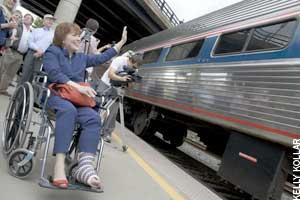

A new, daily Amtrak train that will stop in Charlottesville before going to Washington and the Northeast received much fanfare on Wednesday as it rolled into the city’s West Main Street station.